
Is your digital marketing actually growing your business or just making your dashboards look impressive?
That question sits at the center of almost every marketing meeting today. Someone pulls up charts. Numbers go up. Everyone nods. Then the meeting ends, and revenue still feels uncertain. Digital marketing promised clarity. Transparency. Measurable success. And it delivered data, lots of it.
But data alone doesn’t pay salaries. Or keep investors calm. Or justify next quarter’s budget. What matters is impact. Real impact.
This article takes a deeper, more honest look at digital marketing not as a checklist of tactics, but as a business driver. We’ll talk about the metrics that actually move the needle. The ones executives care about. The ones that tell a story, not just fill a spreadsheet.
Understanding Digital Marketing’s Role in Modern Business
Digital marketing didn’t start as a strategic pillar. It crept in quietly. A website here. A Facebook page there. Then Google ads. Email campaigns. Influencers. Automation. Suddenly, it was everywhere.
Today, digital marketing sits at the center of how businesses attract, convert, and retain customers. It touches nearly every stage of the customer journey. First impression. Consideration. Purchase. Loyalty. Sometimes all in one afternoon.
And here’s the thing. Digital marketing doesn’t just support business anymore. It shapes it. Pricing strategies. Product launches. Customer experience. Even supply chain decisions. When used well, marketing data becomes business intelligence. When used poorly, it becomes noise.
From Vanity Metrics to Value Metrics
What are Vanity Metrics?
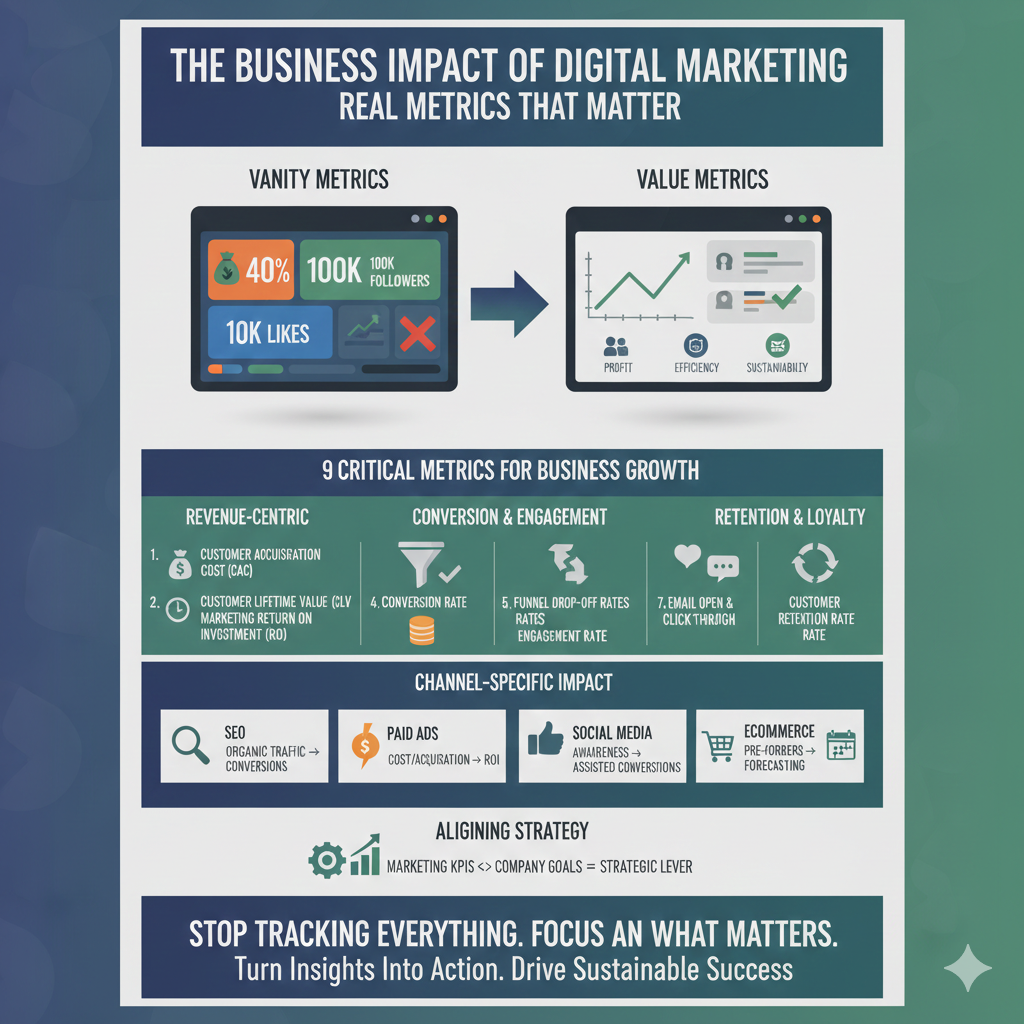
Let’s be honest. Vanity metrics feel good. They’re easy to share. Easy to celebrate.
“Traffic is up 40%.”
“We hit 100,000 followers.”
“This post got 10,000 likes.”
Sounds great. Looks great. Means very little on its own. Vanity metrics don’t tell you if the right people are paying attention. Or if anyone is buying. Or if they’ll come back. They create comfort, not clarity.
What are Value Metrics?
Value metrics are less flashy. Sometimes uncomfortable. They force harder conversations.
How much did this customer cost us?
Did this campaign actually make money?
Are we growing or leaking revenue quietly?
These metrics connect marketing activity to business outcomes. Profit. Efficiency. Sustainability. They don’t always trend upward. But they tell the truth. Mostly.
Revenue-Centric Metrics That Matter Most
1. Customer Acquisition Cost (CAC)
Every customer has a price tag. Whether you calculate it or not. Customer Acquisition Cost tells you how expensive growth really is, from a financial perspective. Ads. Tools. Salaries. Agencies. All of it. Divided by how many customers you gained. Simple math. Brutal insight.
If CAC keeps rising while revenue stays flat, something’s broken. Maybe targeting and maybe messaging. Maybe expectations. Smart businesses track CAC by channel. Because not all customers cost the same, and not all customers are worth the same either.
2. Customer Lifetime Value (CLV or LTV)
Now for the other side of the equation. Customer Lifetime Value asks a longer question. Not “Did they buy?” but “How long did they stay?” How much did they spend over time? Did they upgrade? Refer others? Disappear quietly after one transaction?
Digital marketing shines here. Personalization. Email flows. Retargeting. Loyalty programs. All designed to extend the relationship. High LTV gives you freedom. You can spend more to acquire customers. Experiment more. Scale faster. Low LTV does the opposite. It tightens everything.
3. Marketing Return on Investment (ROI)
This is the metric everyone asks about. Often too late. Marketing ROI answers a simple question. Did we make more money than we spent? That’s it. No fluff.
It’s also the metric most teams avoid calculating honestly. Attribution gets messy. Data lives in different systems. Some campaigns “support” sales rather than drive them directly. Still, ROI matters. Because marketing is not an art alone, it’s a business function. And businesses survive on returns.
Conversion Metrics That Drive Growth
4. Conversion Rate
Traffic is potential. Conversion is reality. Conversion rate tells you how persuasive your experience really is. Your messaging. Your design. Your offer. Your timing.
Low conversion rates often point to small problems. A confusing headline. A slow page. A form that asks too much. Fixing those details doesn’t sound glamorous. But it works. Often better than doubling ad spend.
5. Funnel Drop-Off Rates
Picture your sales funnel. Now imagine people quietly leaving it at every stage.
They browse. Then leave.
They add to the cart. Then hesitate.
They start checkout. Then vanish.
Drop-off rates reveal where trust breaks. Or friction appears. Or doubt wins. Digital marketing teams who obsess over this data tend to outperform those chasing more traffic instead.
Engagement Metrics That Signal Customer Intent
6. Engagement Rate
Engagement is a signal. A subtle one. Time on site. Scroll depth. Video watch time. Comments. Saves. These don’t equal revenue, but they whisper intent.
Highly engaged users are thinking. Considering. Comparing. They’re closer to action than passive viewers. Ignoring engagement metrics is like ignoring body language in a conversation. You still hear the words. You miss the meaning.
7. Email Open and Click-Through Rates
Email isn’t exciting anymore. That’s exactly why it works. Inbox is personal. Permission-based. Direct. When someone opens your email, they choose you over everything else competing for attention. Open rates show trust. Click-through rates show relevance. Together, they tell you if your message landed or missed completely.
Retention and Loyalty Metrics
8. Customer Retention Rate
Growth is addictive. Retention is sustainable. Retention rate shows how many customers stick around. Month after month. Purchase after purchase.
Digital marketing plays a quiet but powerful role here—post-purchase emails. Educational content. Personalised offers. All designed to say, “We remember you.” And customers notice that even if they don’t say it.
9. Churn Rate
Churn is the metric nobody likes to present. It tells you how many customers walked away. And didn’t look back. High churn hurts more than low acquisition. Because it means something deeper is wrong. Expectations. Experience. Value perception. Digital data helps diagnose churn early before it becomes a trend. Or a crisis.
Channel-Specific Metrics and Their Business Impact
Search Engine Optimisation (SEO)
SEO is patient. Slow. Sometimes frustrating. But when it works, it works quietly and consistently. Organic traffic. High intent. Low marginal cost. The real metric isn’t rankings. It’s conversions from search because traffic without intent is just digital noise.
Paid Advertising (PPC)
Paid ads are fast. Measurable. Dangerous if unmanaged. Cost per click. Cost per acquisition. Return on ad spend. These numbers move daily. Sometimes hourly. Scale without discipline and margins disappear. Scale with data and paid media becomes predictable growth. Almost boring. In a good way.
Social Media Marketing
Social rarely closes the sale directly. And that’s okay. Its power sits earlier. Awareness. Trust. Familiarity. Being present when the customer is ready. The mistake is measuring social only by likes. The smarter move is tracking assisted conversions and referral behavior over time.
Digital Marketing and eCommerce Performance
In eCommerce, marketing and operations blur fast. Campaigns affect inventory. Promotions affect fulfillment. Messaging affects demand forecasting.
Take product launches. Or limited releases. Or early access campaigns. Businesses that allow customers to place pre order for WooCommerce products use digital marketing not just to sell, but to predict.
Emails gauge interest. Ads test demand. Data informs stock levels. Using a WooCommerce pre-order plugin turns marketing insights into operational confidence—fewer surprises. Better cash flow. Less risk.
That’s marketing impacting the business, not just the website.
Attribution Models: Understanding What Really Works
Attribution is messy. Always has been. Customers don’t move in straight lines. They click on an ad. Read a blog. Ignore emails. Return through search. Buy days later.
Last-click attribution oversimplifies reality. First-click ignores the journey. Multi-touch models try to be fair. None is perfect. But imperfect insight beats blind spending. Understanding influence, not just credit, changes how teams invest and optimize.
Aligning Marketing Metrics with Business Strategy
The strongest marketing teams speak the language of the business. Not impressions. Not reach. But growth. Efficiency. Profitability. When KPIs align with company goals, marketing stops being a “cost center.” It becomes a strategic lever. Something leadership trusts. And funds. This alignment doesn’t happen automatically. It’s built through shared dashboards. Honest reporting. And sometimes uncomfortable conversations.
Turning Insights into Action
Insight without action is decoration. Real impact comes from doing something with the data, adjusting spend, rewriting messaging, killing underperforming campaigns and doubling down on what works. The teams that win aren’t the ones with the most data. They’re the ones who decide faster. Test more. Learn quicker. And move on.
Conclusion
Digital marketing is not about being everywhere and or tracking everything. It’s about focusing on what matters. The metrics that matter tell a story. About customers. About value. About growth that lasts beyond the next report.
When businesses stop chasing vanity and start measuring impact, marketing becomes more than promotion. It becomes a driver of smarter decisions, stronger relationships, and sustainable success. And in a world full of noise, that clarity is a competitive advantage.